Department of Oh Get Over Yourself You Big Tart

From the Beeb:

“A legal battle has begun in an attempt to stop prayers being said before a Devon council’s meetings.

The National Secular Society (NSS) is seeking a judicial review over whether prayers said at Bideford Town Council breach human rights legislation.”

No. They don’t. Legislation, maybe, that being a purely artificial construct. Human rights, no.

The regime currently ruling Burma/Myanmar breaches human rights.

The Taliban breach human rights.

A town council that has voted, twice, to keep the prayers before its meetings start isnot breaching human rights. You don’t like it, turn up to meetings five minutes late. Or mutter “arse” when everyone mutters “amen”. Or whatever. Exercise your own human rights in response. But stop whining when a democratic vote offends you.

And while I’m in full Tunbridge Wells mode, telling a teenager to pull his trousers up doesn’t breach his human rights either. I’m reasonably certain my right not to have a human backside thrust into my face takes priority.

End of rant. Resume your lives.

What to do on a bank holiday weekend

You could go on the Sarsen Trail, choosing either the 7 mile, 11 mile or 26 mile option. Any of these would involve getting up around 5am, probably earlier, and paying money for the privilege of walking through most of May’s monthly rainfall and freezing temperatures across Salisbury Plain, admiring the beautiful views you would be getting on a clear, sunny, warm day. Depending on which of the above options you choose you could also get to hang around in the cold and wet for a minimum of one coach trip to take you back to your starting place. (That’s the 7 miles, taking you back to Avebury. For the other two you park at Stonehenge and a coach takes you to the Avebury starting point. If you bail out at 11 miles then another coach brings you back to Stonehenge. And did I mention all this happens in the cold and wet?)

Or, you could not.

We didn’t.

We went instead to the morning service at Sherborne Abbey, for no particular reason except that I haven’t been to a service there since leaving school in 1983, and we had already budgeted mentally for getting up early (just not as penitentially early), and we could drive there in a warm, dry car through the rain and look at the sky to the west and think, hmm, it’s probably still wet for the walkers. And a lovely sung eucharist service it was too, appealing to the senses of sight and sound. The choir were tuneful and skilled and didn’t bang on too long with the set musical pieces; and, despite or perhaps because of five years of compulsory services there, I hadn’t appreciated how lovely the abbey looks. A few centuries ago there was a fire which discoloured the sandstone to a pinkish-red. The place is now decorated with that in mind, subdued reds amidst all the usual ornamental bells and whistles of ecclesiastical architecture, and it works very nicely.

Also nice:

  • being dispensed the wine by Mr David “Billy” Smart, retd: former maths teacher whose rapid-fire Ulster-intonated mathematical pedagogy influenced a generation of boys and makes Tom Lehrer look a little slow, and a key influence in my own spiritual development.
  • seeing in the abbey newsletter that the old school is getting a lady chaplain.

Less nice was the pre-service chat a member of clergy had with the lady sitting behind us, who was obviously a regular. “So, how are you?” Well …” And, unfortunately, she told him, in full symptomatic detail, for about 10 minutes, at the end of which Best Beloved whispered to me, “I don’t want to take communion any more …” She only went through with it after working out that we were sitting in front and so would get to the chalice first.

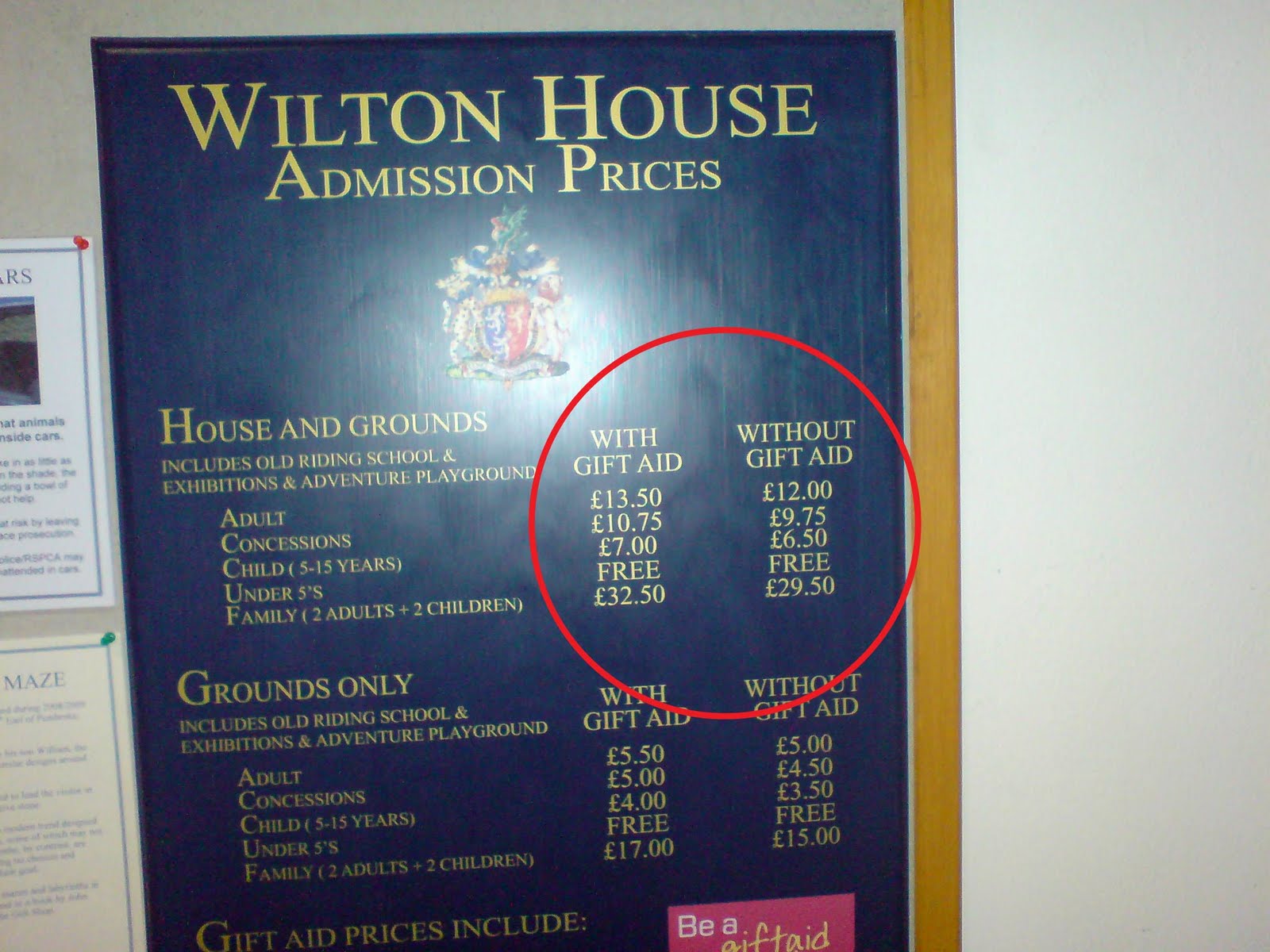
Then we ate our sandwiches in a layby on the A30 overlooking the Fovant regimental badges cut into a hillside, with the intent of using our temporarily bored-teenager-free window of opportunity to looking around Wilton House. This intention lasted as long as getting through the door of the ticket office and seeing this:

Pardon?

The point of Gift Aid is surely that it augments the price paid at no cost to yourself? So, they expect us taxpayers to pay slightly more than the already high basic rate for the privilege of augmenting their income even further? I think not. Besides, Best Beloved picked up a pamphlet for Mompesson House, only five minutes away and a fraction of the price, so we went round that instead. It’s also a fraction of the size of Wilton House, but even though it belongs to a bygone age it retains the sense of actually being a home that real people lived in, once.

And did I mention how warm and dry all this was?
6 of one, less of the other

I asked some friends if any had seen the remade series of The Prisoner. One replied: “The new series of The Prisoner is based around a deep, central mystery: how did Ian McKellen get involved in this load of ####?”
That may be a little unfair. Possibly only a little.
The premise of the original, as surely any fule kno: a high-ranking security agent resigns from his job without explanation; is abducted abruptly by parties unknown; and wakes up in the Village, a mysterious community where everyone is known by a number, ruled over by the no-sniggering-please No. 2.
(“Who is No. 1?” / “You are No. 6” – an exchange in the opening credits of each episode that may or may not answer the question.)
They want to know why he resigned. He wants to escape. He passes his time with various escape attempts, being frightfully British and driving the current No. 2 (usually a new face each week) insane, all with different degrees of success.
I missed the first of the new series, watched the second, and thought, yeah, they’ve got it in a typical non-linear post-Lost sort of way. Then I watched the first of the original series, for the first time in ages, and realised how immensely superior it is and always will be in almost every way.
Things the new series does well:
  • Ian McKellen as No. 2, now a permanent fixture in each episode.
  • A bigger and better Village that looks like it could indeed support a sizeable community like this. Some of the denizens have four-figure numbers, broken into convenient couplets like 11-12 rather having to address someone as One Thousand One Hundred and Twelve every time you meet. The original Village was bigged up by clever camera angles, but in the first episode we get to see it from the air and realise how tiny it is. I like the way the new Village even has its own holiday resort, a short bus ride away through the desert.
  • They’ve kept Rover, bless them: the most impractical security system ever but what the heck. (“Why did you think a big balloon would stop people?” / “Shut up! That’s why!”)
Things it does less well … (Note that I don’t say badly because that would be unfair.)
Old No. 6, played by Patrick McGoohan, is rude, cynical, abrasive, thinks nothing of hurting the feelings of other people, and so of course is an excellent hero for a TV series. New No. 6, played by Jim Caz- Cav- him what was Jesus in The Passion of the Christ tries for the Clive Owen blokey vibe but really is quite forgettable.
Fatally, we are getting flashbacks that actually show Nu-6’s life before the Village: we might even be getting the story of why he resigned. Eek! No! The whole point is that we never did find out. The Prisoner was about the telling and not the finding out, because that way everyone could form their own theories, and if McGoohan had gone and told us – assuming he actually knew, which is debatable – then 99% of the audience would have ended up disappointed and it would almost certianly not have become the cult it did. The entire story of 6’s life, or rather, all we needed to know, was told in the opening credits, and that includes the first episode. Everything else that 6 had to say to the world came out through his various adventures. The opening credits took 2 mins 58 seconds, which is probably way too long for today’s ADD generation: but, it means that from the 179th second of the series, 6 was trying to escape. Nu-6 took until about halfway through episode 2 to make vague gestures in that direction. Oh, come on.
No. 2 has a wife and son, or at least, a tender-faced smileless young man (the aforesaid 11-12) who is believed to be his son. Again, no. Just … no.
For all its strengths, life in the new Village is also just too down-to-earth. Inhabitants actually ask fatal premise-puncturing questions like “do you think this man and woman had children and raised a family just so they could confuse you?” The answer to original 6 would have been a resounding “yes!” The series was all about Patrick McGoohan, so, yes, why not? Fact is: it was colourful, surreal and sixties and it can’t be recreated in any other time period.
And finally, though some might call it nit-picking: there’s no tune. Oh, there are closing credits and some kind of music plays over them but, like most such things nowadays, they are designed to be shunted over to one side of the screen so the next programme can be advertised, or an announcer can chat over them, or … look, they’re a contractual obligation for the actors and production crew, that’s all. Whereas in the olden days no episode was over until McGoohan’s face had flown at the camera, away from the Village, blocked at the last minute by bars that clanged shut, and then you’d sat through the credits too, watching a surreal penny-farthing bicycle assemble itself for no readily apparent reason while Ron Grainer’s infuriating tune plays at you with no instrument playing a bar for quite long enough.* Without that level of understanding of the original, any remake is fundamentally flawed and doomed.

*Like this.